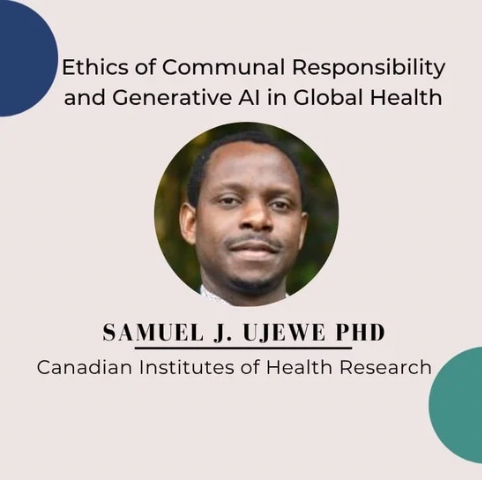
We’re excited to feature Samuel J. Ujewe, PhD – a leading voice on communal responsibility and Generative AI in global health.
Events surrounding the Covid-19 pandemic demonstrated the benefits of AI during global public health emergencies. They also provided insights on the potential future impact of Generative AI (GenAI) towards addressing health issues affecting marginalised and vulnerable populations across the globe. However, beyond its potential benefits, GenAI also has the capacity to strengthen existing gaps, inequities, and discrimination within the global health ecosystem. The global repositories of health data accessible to GenAI are products of individuals’ data aggregated to power the ecosystem. This raises questions of ownership, stewardship, rights, and access, among others. Various approaches to justice struggle to provide a reliable ethics direction for the exploitation and use of GenAItowards advancing global health. This lecture presents the ethics of communal responsibility, founded on the African principles of Ubuntu and moral responsibility, as a viable tool capable of providing ethics guidance for the use and application of GenAIin ways that not only address health challenges affecting disadvantaged populations, but also bridge existing inequities and eliminate discrimination in the global health ecosystem.
Dr. Samuel J. Ujewe PhD is a researcher and specialist in applied ethics and global population health, especially population health ethics, justice and social determinants, infectious disease management, Indigenous health justice, inequities in health emergencies, cross-cultural bioethics, and global mental health. His research interests include integrating major social justice and equity theories with Indigenous principles and approaches to enhance equitable, responsible, and actionable health reforms for the wellbeing of under-served populations. He is widely published in global health ethics, including a co-edited book: “Socio-cultural Dimensions of Emerging Infectious Diseases in Africa: An Indigenous Response to Deadly Epidemics”.