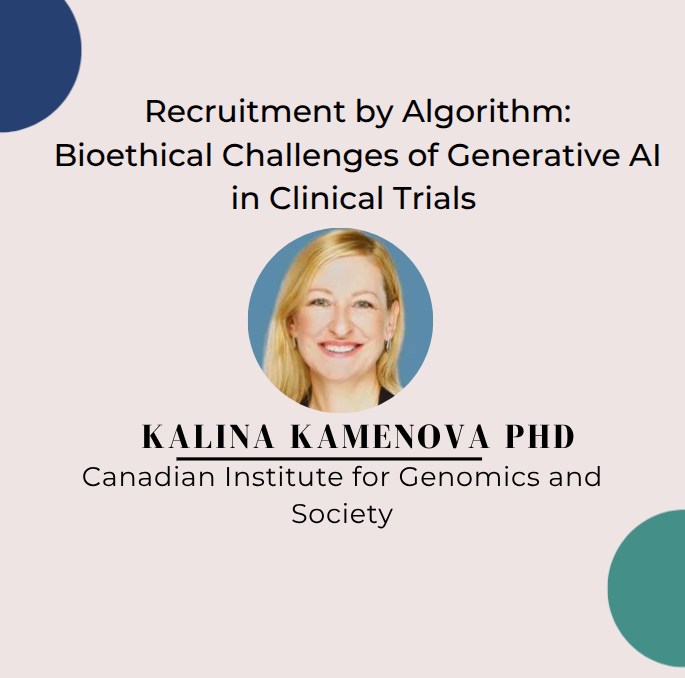

The use of generative artificial intelligence (AI) in clinical trial recruitment is rapidly changing how participants are identified, engaged, and enrolled. While the technology promises efficiency and broader reach, it also raises urgent ethical concerns. First, algorithmic bias in recruitment systems may reproduce or deepen health disparities, threatening efforts to build representative and inclusive clinical studies. Second, reliance on AI-generated patient materials complicates informed consent and transparency, since tailored outputs can obscure critical risks, oversimplify complex medical information, or frame participation in ways that undermine trust. Third, the integration of AI into recruitment workflows necessitates enhanced frameworks for accountability and responsible governance. Unlike traditional recruitment processes, generative AI involves layers of opacity, raising difficult questions about responsibility for errors, bias, and participant harm. Without strong regulatory oversight, the rapid adoption of AI-driven tools risks undermining participant protections and public trust in clinical research.
 
Kalina Kamenova PhD is Founder and Research Director of Canadian Institute For Genomics And Society | Toronto. Her work integrates bioethics, science policy, and public engagement strategies to shape evidence-based decisions in health and biomedical innovation, including genomics, precision medicine, stem cell and regenerative therapies, and artificial intelligence (AI) in healthcare. As Founder and Research Director of the Canadian Institute for Genomics and Society (Genomics4S), I have advanced participatory research, ethical governance, and policy innovation in emerging biotechnologies. Partnering with leading researchers, scientists, policymakers, and industry stakeholders, I have enabled strategic collaboration on initiatives that navigate the ethical and societal dimensions of biomedical innovation. With prior leadership experience at Loyalist College’s Applied Research and Innovation Office and University of Alberta’s Centre for Public Involvement, I have also contributed to fostering cross-sectoral innovation through applied research, policy development, and strategic partnerships. My executive and management expertise spans research administration, grant development, research ethics, team-building, and stakeholder engagement. I am driven by a commitment to responsible research and innovation, ensuring inclusive public discourse around transformative scientific advancements.

Other Posts

A recent piece from The Atlantic explores families carrying the CDH1 gene mutation, which can give carriers up to a 70% lifetime risk of developing an aggressive and hard-to-detect form of stomach cancer. Among those [...]

Policy changes in Mississippi have weakened longstanding vaccine requirements. A recent Guardian report links the shift to a resurgence of preventable diseases, including rising whooping cough cases and a child death. Once a state with [...]

Two more women have joined an ongoing lawsuit challenging Arkansas's near-total abortion ban. One plaintiff, Leitaea Lowrimore, was turned away by three emergency rooms while experiencing a potentially fatal ectopic pregnancy, driving three hours to [...]

The Trump administration recently announced that the EPA would move to classify microplastics and pharmaceuticals as priority pollutants in drinking water, a step that could unlock federal research and potentially lead to new water quality [...]

After Idaho eliminated Medicaid-funded outreach services for people with severe mental illness as part of broader budget cuts, at least four people who had been enrolled in the program died within weeks. The program provided [...]

Patients are increasingly using AI tools like ChatGPT and Claude to understand and dispute confusing medical bills and insurance denials. Results have varied, with some successfully getting bills waived, while others received advice that was [...]