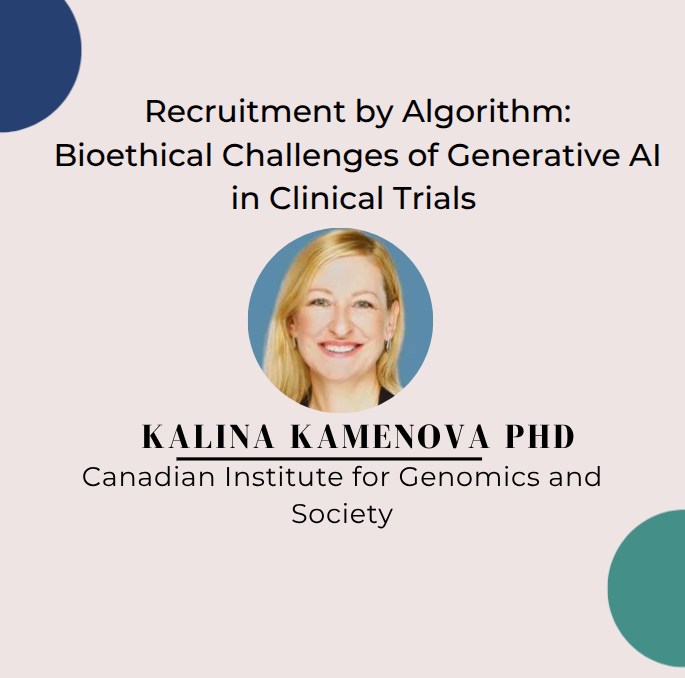

The use of generative artificial intelligence (AI) in clinical trial recruitment is rapidly changing how participants are identified, engaged, and enrolled. While the technology promises efficiency and broader reach, it also raises urgent ethical concerns. First, algorithmic bias in recruitment systems may reproduce or deepen health disparities, threatening efforts to build representative and inclusive clinical studies. Second, reliance on AI-generated patient materials complicates informed consent and transparency, since tailored outputs can obscure critical risks, oversimplify complex medical information, or frame participation in ways that undermine trust. Third, the integration of AI into recruitment workflows necessitates enhanced frameworks for accountability and responsible governance. Unlike traditional recruitment processes, generative AI involves layers of opacity, raising difficult questions about responsibility for errors, bias, and participant harm. Without strong regulatory oversight, the rapid adoption of AI-driven tools risks undermining participant protections and public trust in clinical research.
 
Kalina Kamenova PhD is Founder and Research Director of Canadian Institute For Genomics And Society | Toronto. Her work integrates bioethics, science policy, and public engagement strategies to shape evidence-based decisions in health and biomedical innovation, including genomics, precision medicine, stem cell and regenerative therapies, and artificial intelligence (AI) in healthcare. As Founder and Research Director of the Canadian Institute for Genomics and Society (Genomics4S), I have advanced participatory research, ethical governance, and policy innovation in emerging biotechnologies. Partnering with leading researchers, scientists, policymakers, and industry stakeholders, I have enabled strategic collaboration on initiatives that navigate the ethical and societal dimensions of biomedical innovation. With prior leadership experience at Loyalist College’s Applied Research and Innovation Office and University of Alberta’s Centre for Public Involvement, I have also contributed to fostering cross-sectoral innovation through applied research, policy development, and strategic partnerships. My executive and management expertise spans research administration, grant development, research ethics, team-building, and stakeholder engagement. I am driven by a commitment to responsible research and innovation, ensuring inclusive public discourse around transformative scientific advancements.

Other Posts

Antiabortion groups are increasingly turning against President Trump over continued access to abortion pills during his second term. Despite promises of stronger national restrictions after the fall of Roe v. Wade, the administration has left [...]

Hantavirus is a rare, incurable virus transmitted through contact with infected rodents, and a recent outbreak aboard the cruise ship MV Hondius has put it in the global spotlight. Three passengers died and several others [...]

The Trump administration quietly eased part of its travel ban, allowing foreign doctors already in the U.S. to resume visa and work permit renewals after hospitals warned of disruptions to patient care. The restrictions had [...]

Artificial intelligence is increasingly shaping how humanitarian decisions are made, from processing asylum claims to determining who receives aid. In systems already structured around definitions of vulnerability, AI may not just accelerate decisions, but reshape [...]

Access to fertility care in Europe is far from equal. Starting a family is often shaped by laws, cost, and geography rather than personal choice alone. Legal restrictions and limited public coverage mean access depends [...]

Polygenic embryo screening is a new IVF technology that lets parents assess embryos for genetic risk, from heart disease to, controversially, intelligence and height. While marketed as a path to healthier babies, the science is [...]