
2026 Fall School
Keynote Speakers
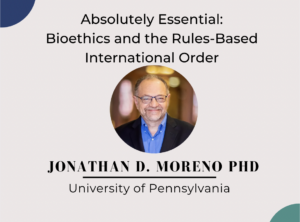
Jonathan D. Moreno PhD is the David and Lyn Silfen University Professor at the University of Pennsylvania, where he is a Penn Integrates Knowledge (PIK) professor. At Penn he is also Professor of Medical Ethics and Health Policy, of History and Sociology of Science, and of Philosophy. His most recent books are Everybody Wants to Go to Heaven but Nobody Wants to Die: Bioethics and the Transformation of Healthcare in America, co-authored with Penn president Amy Gutmann; and The Brain in Context: A Pragmatic Guide to Neuroscience, written with neuroscientist Jay Schulkin. Among Moreno’s previous books are, The Impromptu Man: J.L. Moreno and the Origins of Psychodrama Encounter Culture and the Social Network and The Body Politic which was named a Best Book of 2011 by Kirkus Reviews; Undue Risk, nominated for the Virginia Book Award; and Mind Wars, which was referenced by the screenwriter of The Bourne Legacy. He has published more than a thousand papers, articles, reviews and op-eds. Moreno’s writings have been translated into German, Japanese, Korean, Portuguese and Romanian. Moreno is senior consultant to a six-year, 10 million euro project on cold war medical science on both sides of the iron curtain, funded by the European Research Council. Moreno’s op eds have been published in venues including The New York Times, The Wall Street Journal, Science, Nature, Slate, Politico, The Hill, Foreign Affairs, Axios.com, The Huffington Post, and Psychology Today. He often appears on broadcast and online media. He was co-host of Making the Call, an Endeavor Content podcast and was a columnist for ABCNews.com. Formerly Moreno was a senior fellow at the Center for American Progress in Washington, DC. and editor of the online magazine Science Progress. The American Journal of Bioethics has called him “the quietly most interesting bioethicist of our time.” Moreno is an elected member of the National Academy of Medicine. He has served as a staff member or adviser to many governmental and non-governmental organizations, including the UNESCO International Bioethics Committee, three U.S. presidential commissions, the Department of Defense, the Department of Homeland Security, the Department of Health and Human Services, the Centers for Disease Control, the Federal Bureau of Investigation, the Howard Hughes Medical Institute, and the Bill and Melinda Gates Foundation. In 2008-09 he served as a member of President Barack Obama’s transition team. Moreno received his Ph.D. in philosophy from Washington University in St. Louis, was an Andrew W. Mellon post-doctoral fellow, holds an honorary doctorate from Hofstra University and is a recipient of the College of William and Mary Law School Benjamin Rush Medal, the Dr. Jean Mayer Award for Global Citizenship from Tufts University, and the Penn Alumni Faculty Award of Merit. He has held the honorary Visiting Professorship in History at the University of Kent in Canterbury, England. In 2018 the American Society for Bioethics and Humanities presented him with its Lifetime Achievement Award. Jonathan D. Moreno, PhD
Absolutely Essential: Bioethics and the Rules-Based International Order
In my new book Absolutely Essential, I explore the field of bioethics as both a creature and a key element of the post–World War II rules-based order. According to this order, international relations are to be organized according to principles of open markets, liberal democracy, and multilateral organizations. In the book I raise key questions about the future of bioethics in a changed world order, while also theorizing new ways to think about bioethics after the COVID-19 pandemic and the reordering of global alliances.

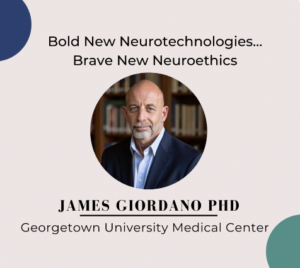
Bold New Neurotechnologies…Brave New Neuroethics
Current and emerging neurotechnologies are affording boldly unparalleled ability to assess, access, and affect the human brain and its functions of cognition, emotion, and behavior. In many ways, this trajectory is forging an iterative, multidimensional interface between machines and minds, as advancements in neurotechnology are being multinationally developed and engaged in a variety of applications in medicine, daily life, and human relations across scales and cultures upon the global stage. While aimed at achieving definable goods, such bold strides also generate questions and issues of ‘good for whom; in what ways, and with what burdens, risks or harms?’ To address these concerns, an approach to neuroethics is proposed that is cosmopolitan in scope, focal in vision, principled in form and brave in its functions to prescribe and not just proscribe, and be creative and not merely constraining.